
Use Case: Protecting an Existing Urban Trackside Cabinet Against Vandalism
A SafeBox AV use case for adding a reinforced protective enclosure around an existing cabinet in a location exposed to unauthorised access and deliberate damage.
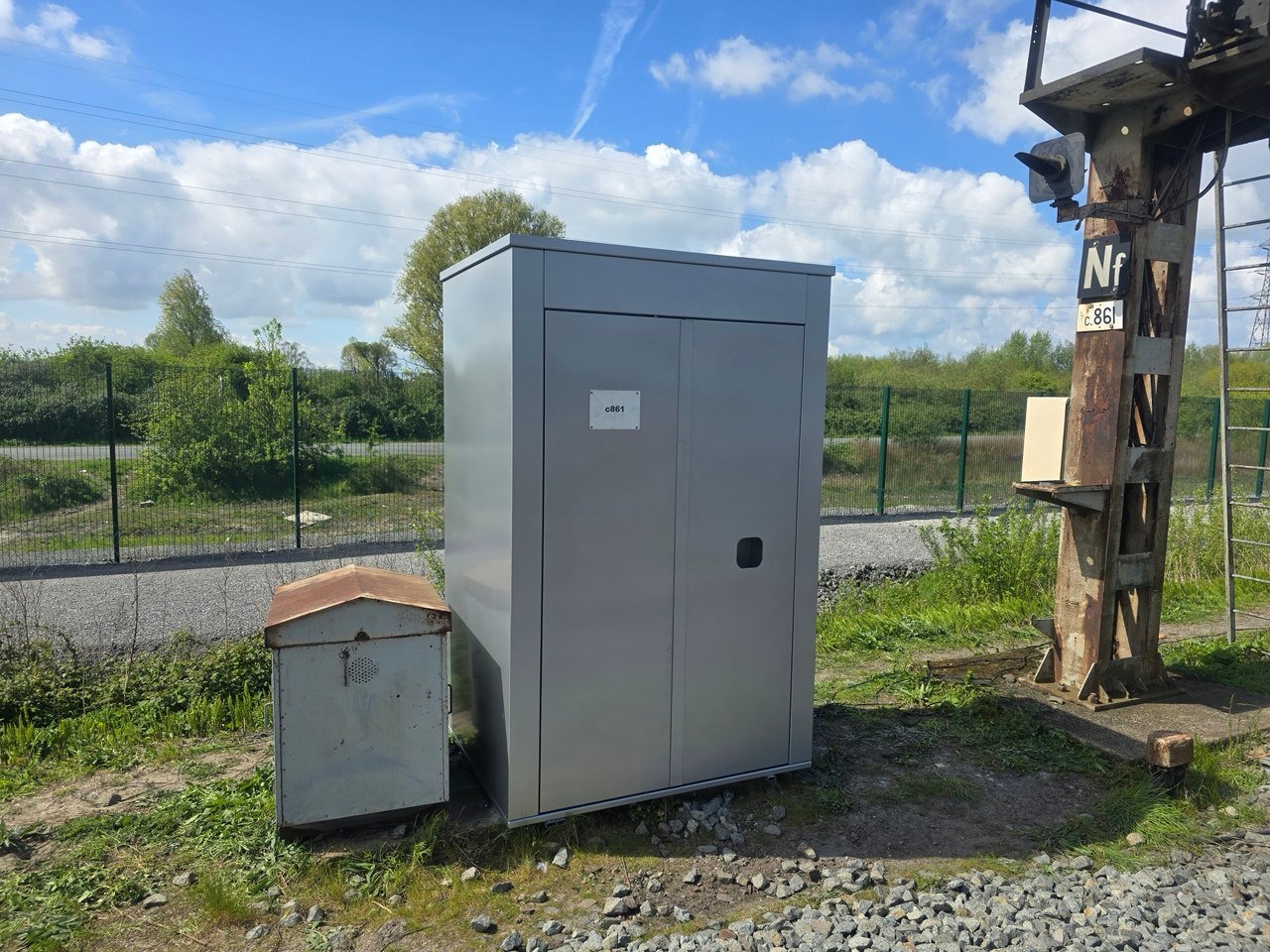
This is an illustrative engineering use case based on documented ALIAS product capabilities. It is not a named customer project, a site-specific design or a performance guarantee.
Urban site context
A serviceable trackside or roadside technical cabinet sits close to a public boundary, access route or area with a history of unauthorised interference. The equipment inside remains operational, but the existing outer structure does not provide the level of physical protection now required.
A complete equipment replacement would add cost and technical risk without necessarily solving the site’s main problem: exposure to vandalism and forced-entry attempts.
Use-case objective
The objective is to strengthen physical protection around the existing cabinet while limiting changes to the infrastructure beneath and inside it. SafeBox AV is designed as a reinforced external enclosure that can be installed over an existing cabinet where the survey and configuration permit.
The solution must remain maintainable. Security should not prevent authorised access, inspection or future equipment work.
Relevant SafeBox AV features
- Reinforced welded steel construction.
- Four-point locking using 25 mm diameter hardened steel bars.
- Hidden hinges intended to reduce exposed attack points.
- No externally visible assembly elements in the designed configuration.
- No exterior-accessible screws or bolts.
- C5M external corrosion protection for aggressive environments.
- Ventilation openings reproduced where the existing equipment requires them.
Site assessment
The survey should record cabinet dimensions, door operation, maintenance clearances, slab condition, cable routes, ventilation, surrounding fences and the likely direction of attack. The team must also understand how authorised maintainers will approach and open the enclosure.
A stronger outer enclosure is effective only when the base, door geometry, lock arrangement and adjacent site boundary do not create a simpler route around it.
Installation approach
SafeBox AV has a typical installation time of approximately four hours, subject to site and operational conditions. The installation may reuse or extend the existing concrete slab where the engineering assessment confirms stability and the extension plan is approved.
The work sequence should protect the existing equipment, preserve required ventilation, verify the four-point locking action and confirm that no new external fixing points have been introduced.
Balancing maintenance and security
An anti-vandal enclosure should make unauthorised access more difficult while keeping authorised work practical. Door opening, lock operation, internal clearances and any removable panels should be assessed with the maintenance team before the final configuration is released.
The completed asset should be inspected for damage, attempted entry, corrosion, blocked vents and changes to surrounding access conditions as part of planned maintenance.
Appropriate use of the solution
SafeBox AV is intended to improve resistance to vandalism and forced entry. It should not be described as an absolute guarantee against all attacks or as suitable for every threat without a site-specific risk assessment.
For an urban asset with serviceable internal equipment, it provides a focused way to upgrade the protective envelope while limiting unnecessary changes to the installed system.
ALIAS Engineering
We design and install modular enclosures for signalling, telecom and energy assets across European rail networks. Field notes from our installation teams are published here as they are cleared.